It’s the dinosaur I know best. I spent my master’s at NC State figuring out how it grew (my thesis), which meant a lot of hours hunched over a microscope looking at slices of its leg bones. Almost nobody has heard of it, and that drives me a little crazy, because it’s one of the closest relatives T. rex has. So let me tell you about it.
What is Tarbosaurus?
It was a big tyrannosaur from Mongolia, near the very end of the age of dinosaurs. Its bones come from a rock unit called the Nemegt Formation, and a 2013 study of tyrannosaur relationships used an age of about 70.6 million years for it (Loewen et al., 2013).
The name is great. Hurum and Sabath translate Tarbosaurus as “horrible lizard” (from the Greek tarbos, terror), and the species name bataar is a misspelling of the Mongolian word baatar, hero (Hurum & Sabath, 2003). Horrible lizard hero. I love that.
It had a lot of company, too: Saurolophus, Deinocheirus with those ridiculous arms, Therizinosaurus and its giant claws, and some long-necked sauropods (Park et al., 2021). There was even a second, smaller tyrannosaur with a long, skinny snout, Alioramus (Brusatte et al., 2009).
Is Tarbosaurus a real dinosaur?
Yes! Museums in Warsaw, Moscow and Ulaanbaatar hold dozens of Tarbosaurus skulls and skeletons, from little juveniles to huge adults (Hurum & Sabath list them). I think people ask because it shows up in games and toy aisles but almost never in a classroom. Where scientists do argue is over what to call it.
Is Tarbosaurus a Tyrannosaurus?
It started out as one. Evgeny Maleev first named it Tyrannosaurus bataar in 1955. He named a few more Mongolian tyrannosaurs around the same time that turned out to be the same animal, and in 1965 Anatoly Rozhdestvensky lumped them all together as Tarbosaurus bataar.
Gregory Paul put it back in Tyrannosaurus in 1988, Thomas Carr did too in 1999, and Thomas Holtz called it “possibly congeneric” with T. rex in 2001 (Hurum & Sabath, 2003).
Most studies now keep them as two different genera that are each other’s closest cousins. A 2013 analysis grouped them as sister groups, with the Chinese tyrannosaur Zhuchengtyrannus closest to Tarbosaurus (Loewen et al., 2013). The 2003 skull study argued they lived differently enough to be separate genera (Hurum & Sabath, 2003).
My favorite twist is from 2016. Brusatte and Carr suggested T. rex’s ancestors may have come over from Asia, and called T. rex “an invasive migrant species” (Brusatte & Carr, 2016). They’re careful to say a second route fits the data just as well, but I love the idea that America’s most famous dinosaur might be an immigrant.
How big was Tarbosaurus?
Big, but not T. rex big. A 2019 study built 3D body models and put one well-preserved Tarbosaurus (ZPAL MgD-I/4) at about 2,250 kilograms, around 5,000 pounds. In the same study Sue the T. rex came out at about 9,130 kilograms (around 20,000 pounds), and another T. rex (AMNH 5027) at about 6,990 (Snively et al., 2019).
All three were modeled the same way, which makes the comparison fair. One specimen just can’t tell you the biggest Tarbosaurus that ever lived.
- Tarbosaurus (ZPAL MgD-I/4)~2,250 kg
- T. rex (AMNH 5027)~6,990 kg
- Sue the T. rex~9,130 kg
From Snively et al. (2019), which modeled all three the same way. Bars are drawn to the same scale.
Sue is more than 40 feet long (Field Museum), but I haven’t found a length for an adult Tarbosaurus from a primary source that I’d stand behind, so I’m not going to give you one.
For the skull, there’s a good number: a subadult in Ulaanbaatar (GIN 100/70) has a skull about 0.8 meters long, roughly 2.6 feet (Hurum & Sabath, 2003).
Tarbosaurus vs. T. rex: how do they compare?
| Tarbosaurus | T. rex | |
|---|---|---|
| Where | Mongolia (possibly China) | Western North America |
| Modeled mass | ~2,250 kg (one specimen) | ~6,990 to 9,130 kg |
| Skull | Narrower, slimmer snout | Very broad at the back |
| Nose bones | Domed, loosely attached | Not domed |
| Upper-jaw teeth | 12 to 13 | 11 to 12 |
| Lower jaw | Bones lock together more rigidly | Less locked |
Sources: Hurum & Sabath, 2003 (skull, nose, teeth, jaw); Snively et al., 2019 (mass).
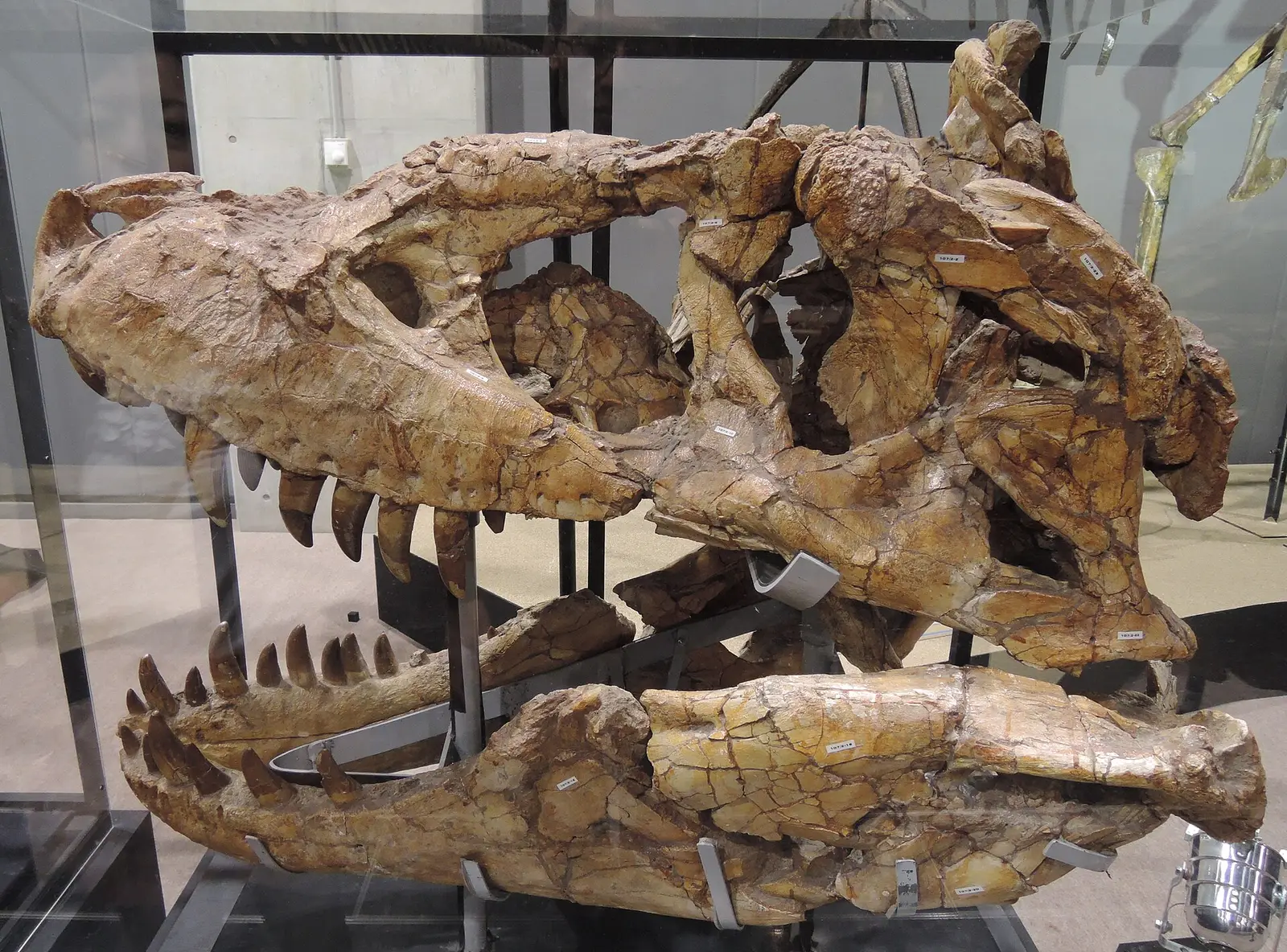
The domed nose is what Hurum and Sabath call “the most obvious difference” between the two. If you ever want to tell them apart at a museum, look at the top of the snout (Hurum & Sabath, 2003). The same paper suggests that the wide back of the T. rex skull helped its depth perception. It’s a neat idea, but nobody’s measured it. There’s also a juvenile from China’s Subashi Formation that might be a young Tarbosaurus (Currie & Dong, 2001).
And yes, I know you want to know who’d win. They lived on different continents, so it never happened. But about 20,000 pounds of T. rex against about 5,000 pounds of Tarbosaurus wouldn’t be much of a fight.
What did Tarbosaurus eat?
Other dinosaurs, and we know some of them by the tooth marks. A Saurolophus arm bone has punctures and drag marks that Hone and Watabe pinned on Tarbosaurus. The rest of that skeleton was untouched, so they think this one was scavenging, picking at something that was already dead (Hone & Watabe, 2010).
Bite marks on the belly ribs of Deinocheirus point to Tarbosaurus as the most likely culprit, too (Bell, Currie & Lee, 2012). Whether that was a kill, we just can’t tell.
What do baby Tarbosaurus tell us?
A ton, because Mongolia has young ones. In 2011 a team described a juvenile skull only 11.4 inches long. The animal was about 9 feet long and 2 to 3 years old, and it was built for speed, so it probably chased smaller prey than the adults did (Tsuihiji et al., 2011; Ohio University).
A CT scan of a juvenile showed its teeth were replaced in a simpler pattern than an adult’s (Hanai & Tsuihiji, 2018). A 2022 study followed how the skull roof changes shape as the animal grows. Those authors also pointed out how few careful growth studies of Tarbosaurus there are (Yun et al., 2022).
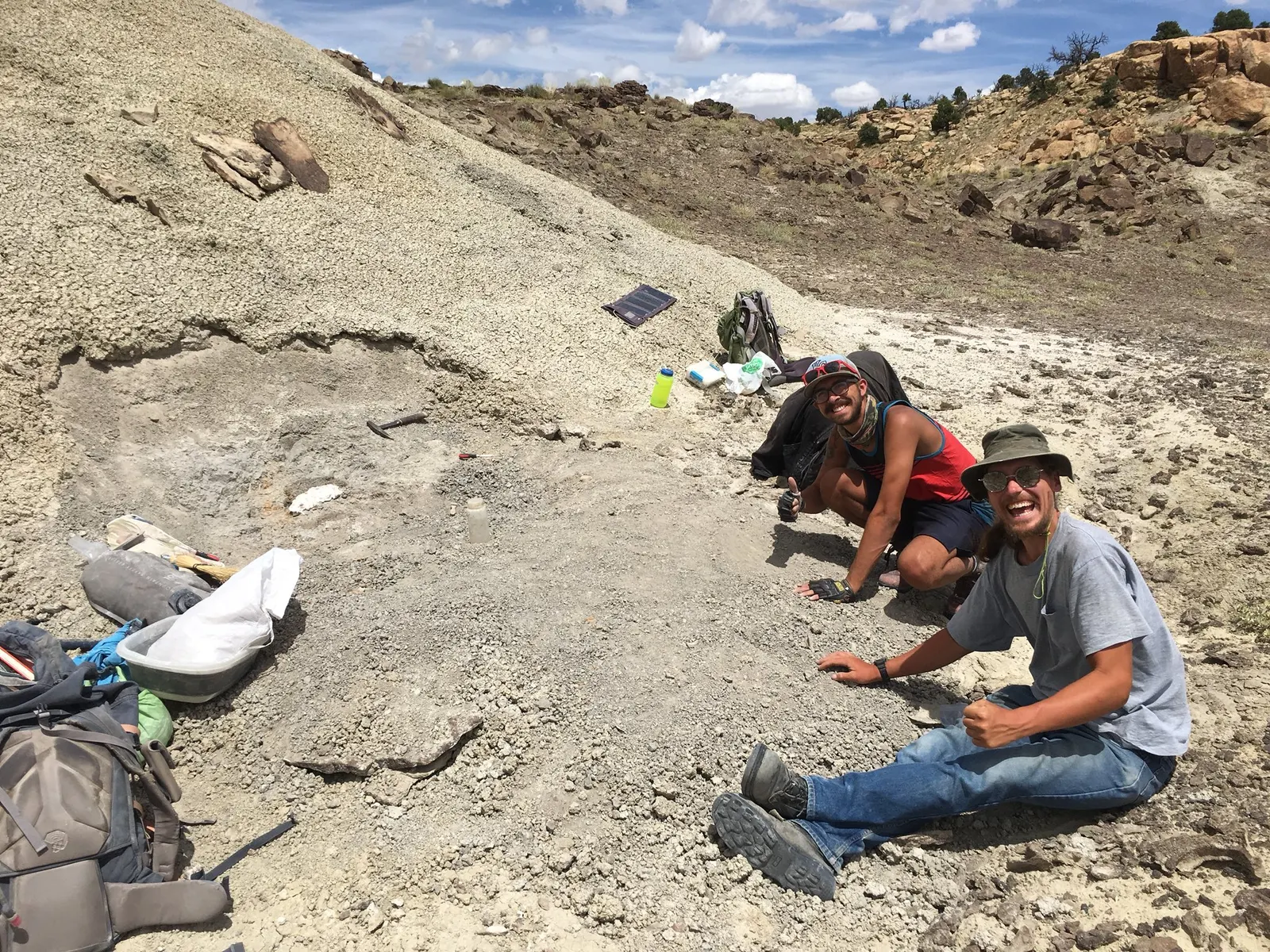
That’s exactly what I spent my master’s on. You cut a thin slice of bone, grind it down until light shines through, and count the growth lines, kind of like tree rings. I did that on Tarbosaurus leg bones from a whole growth series, from small juveniles up to big adults, all in the collections of the Mongolian Paleontological Center.
And I gave them names. The juvenile from that CT tooth study, MPC-D 107/7, was Chicken Nugget. The subadult with the 0.8-meter skull, MPC-D 100/70 (older papers call it GIN 100/70), was Sick Rick. The rest got names like Jitters, Patches, Lil Jobby and Smooth Operator.
Some of the bones even had growth marks that looked like stress, rough patches in the bone that might line up with hard times in its environment. I can’t say for sure what caused every one, but how cool is it that a bone can hold onto a bad year for 70 million years!
The thing that surprised me most was that different bones from the same animal didn’t always tell the same story, and two animals didn’t always grow at the same pace. If someone ages a tyrannosaur from a single bone, I’d be a little skeptical.
I walked through all of this on the NC Museum of Natural Sciences’ Science Tonight back in 2021. That same bone-slicing was a big part of how the Nanotyrannus debate finally got settled in 2025, and I was in the room for that one. What a day!
Why was a Tarbosaurus in a US courtroom?
Because fossils from Mongolia belong to Mongolia, and people steal them.
In 2012, a Tarbosaurus skeleton that had been smuggled into the US sold at a New York auction for $1,052,500. A million dollars for a stolen dinosaur! It came in back in 2010, listed as coming from Great Britain, with a declared value of $15,000. Mongolia’s president asked for help, federal prosecutors seized it, and the seller pleaded guilty. The skeleton was formally returned to Mongolia in May 2013, along with other smuggled fossils (U.S. Department of Justice, 2013).
Want the next one of these in your inbox?
Once a month I break down the coolest new dinosaur papers in the Dino Digest, the way I’d explain them to a friend. It’s free, and I link every source.
Get the Dino Digest →