How much do paleontologists make, by job?
Federal wage data doesn’t track paleontologists, so when a website gives you one exact number, somebody guessed. These are the numbers as of November 2026, and I’ve listed where I got each one.
- Grad student stipend (mine, 2019–21)$18K–$20K
- Mitigation monitor$48K–$67K
- Museum technician / preparator$51K
- Federal agency paleontologist$53K–$118K
- Postdoc (NIH starting stipend)$62K
- Museum curator$63K
- Senior mitigation (California)$77K–$130K
- Assistant professor$100K–$125K
- Geoscientist$102K
- Full professor$169K–$237K
| Job | Pay | Where the number comes from |
|---|---|---|
| Museum technician or fossil preparator | $51,440 median | BLS, May 2025 (museum technicians and conservators). My undergrad prep job at KU paid about $10 an hour. |
| Museum curator | $63,420 median | BLS, May 2025 |
| Grad student | A stipend plus a tuition waiver. Varies a lot by school. | Mine was about $18,000 to $20,000 a year (2019 to 2021) |
| Postdoc | About $56,000 when the jobs study ran. NIH’s FY2025 scale starts postdocs at $62,232. | NIH NRSA stipend levels, which a lot of institutions follow |
| Mitigation monitor | About $23 to $32 an hour | Job postings I reviewed, 2026 |
| Senior mitigation paleontologist | $77,000 to $130,000 | California job postings I reviewed, 2026 |
| Federal agency paleontologist | About $53,000 to $118,000 | OPM federal pay tables, by grade and location |
| Assistant professor | $100,452 (public) to $125,261 (private), average | AAUP 2025–26, Table 1, doctoral universities, all fields |
| Full professor | $168,759 (public) to $237,467 (private), average | AAUP 2025–26, Table 1, doctoral universities, all fields |
| Geoscientist | $101,920 median | U.S. Bureau of Labor Statistics, May 2025 |
Big asterisk on the professor numbers. They average every kind of professor, including business, law, medicine and engineering, so treat them as a rough ceiling for paleontology.
What do you make starting out?
Most new PhDs start on postdoc pay, which is $62,232 on NIH’s FY2025 scale. Jobs you can get with a bachelor’s start lower: about $23 to $32 an hour in mitigation, or around $53,000 at a federal agency.
Most people start as postdocs because there aren’t enough permanent jobs. The best count we have, Plotnick et al., Paleobiology, 2025, found about 7 to 9 permanent paleontology jobs advertised per year from 2019 to 2022, while about 31 people finish paleontology PhDs out of geology departments every year (biology departments weren’t counted). Like I’ve said before, more people make it into Congress than into paleontology. Postdocs are research positions that last 2 to 3 years and end when the project does. A lot of people do two or three in a row, often in different states.
What did I make?
My first paleontology paycheck was from the fossil prep lab at KU as an undergrad: about $10 an hour, barely above minimum wage. I’d have done it for free. I did, for about a year, before they started paying me.
In grad school at NC State I lived on a stipend of $700 to $800 every two weeks, with tuition covered.
After my master’s I took an entry-level environmental consulting job, at $23 to $25 an hour in 2022, about $49,000 a year. A few months later the whole company got a raise (not for performance, everybody got one), and I was in the low $50,000s. That was about what a postdoc made at the time, and I didn’t have a doctorate.
Parents, the bachelor’s is the expensive part. A funded master’s or PhD usually costs little or nothing in tuition, but the stipend is tight. And if you’re switching careers, consulting and agency jobs are where your current degree probably counts most.
What do geoscientists make?
Geoscientists make a median of $101,920 (U.S. Bureau of Labor Statistics, May 2025). There are about 25,400 of those jobs and around 1,800 openings a year, and a lot of them only need a bachelor’s.
The geology degree you earn on the way to paleontology gets people hired on its own, and nobody told me that while I was picking classes.
How can you make more?
The biggest thing is planning for more than the 7 to 9 permanent research jobs. Senior agency and mitigation jobs pay as well as a postdoc or better. Monitoring work comes and goes with projects, though, so ask how many hours you’ll get.
Next is skills. GIS shows up on a huge share of geology job listings, and I never took it. Statistics and R help in research and pretty much everywhere else. Don’t pay for a science grad degree. Most programs are funded. And be ready to move. Postdocs and permanent jobs are rarely in your hometown.
If you want the how-to, I wrote that up here: how to become a paleontologist. My guide below goes step by step.
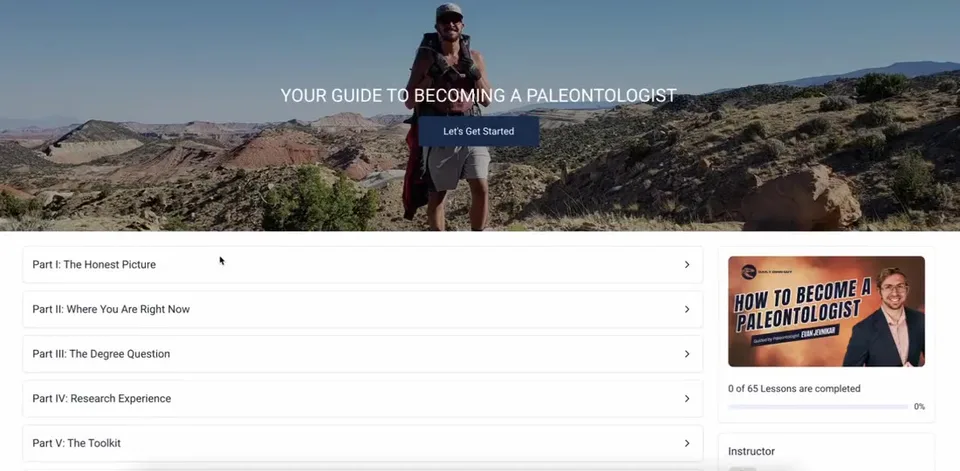
The whole plan, in order
My guide, How to Become a Paleontologist, takes you from picking a major all the way to applying to grad school. I wrote it for students and their parents. $149, or 3 payments of $50, with a full refund within 7 days.
See what’s in the guide →