How many paleontology jobs are there?
Nobody put this in front of me when I was your age, so I’m starting with it.
In 2025, a committee from the Paleontological Society published the best count we have of the paleontology job market (Plotnick et al., Paleobiology, 2025). From 2019 to 2022, an average of 7 to 9 permanent paleontology jobs were advertised per year, for the whole field. That count even includes some jobs in Europe.
Meanwhile about 31 people finish a paleontology PhD every year out of geology departments alone. Nobody counted the ones coming out of biology departments, so it could be double that.
When I first saw those numbers I felt sick. Then I read the rest of the study. It found 88% of new PhDs had a job a year later, and most of those jobs were in paleontology or something close to it. They were mostly postdocs, which are 2 to 3 year research positions that end when the grant does. People often do two or three of them, usually in a different state each time, before they land something permanent.
You can work in paleontology. Landing one of the permanent jobs everyone pictures, like professor or museum curator, is the hard part, and you want a plan for it.
If you’d rather watch, I made a 53-second version of this for YouTube:
What do paleontologists study?
Fossils, and way more than dinosaurs: shells, fossil plants, microscopic fossils, footprints, all of it. Most paleontologists pick one group and one question and stick with it. Mine was how fast tyrannosaurs grew. I wrote up what the job looks like day to day, from digs to the prep lab, in what does a paleontologist do.
What should I do in high school?
Take every science class your school has, plus whatever statistics it offers. Biology and chemistry especially. If there’s an earth science class, take that too.
Outside school, see if a natural history museum near you takes teen volunteers. Fossil clubs are great too. And start reading papers about the animals you love. A bunch of them are free online, and nobody expects you to understand all of it yet. I sure didn’t.
What degree do you need to be a paleontologist?
You need at least a bachelor’s in geology or biology to get paid in paleontology. The permanent research jobs, like professor or curator, need a PhD.
I can’t tell you how many people DM me thinking they need a paleontology degree or they don’t have a shot. You don’t. Only a handful of schools even offer one (Montana State is one).
Paleontology is half geology and half biology, and almost every university puts those in different buildings. You pick one and take classes from the other.
| Major | What you get | The hole you’ll need to fill |
|---|---|---|
| Geology | How to read a rock section, how old it is, why an animal got preserved there | The animal. You can graduate without ever taking evolution or anatomy. |
| Biology | Evolution, anatomy, phylogenetics, genetics, stats | The rocks |
| Earth science | A broader degree: climate, water, environment, sometimes geology | It may not include the rock classes you need. Check the course list before you commit. |
| Paleontology | Both halves in one program | Very few schools have it |
I did geology at the University of Kansas, then switched to biology for my master’s at NC State. Either direction works. Fill the gap with electives, a minor, a double major, or by switching in grad school like I did.
What each paleontology degree gets you
| Degree | How long | What it opens up |
|---|---|---|
| Bachelor’s | 4 years | Mitigation monitoring, fossil prep, entry-level agency and geoscience jobs. |
| Master’s | About 2 years | Collections, senior mitigation, teaching at some colleges, and a big leg up for a PhD. This is where I stopped. |
| PhD | About 4 more years | Postdocs, then professor and museum curator jobs |
Which colleges are good for paleontology?
I can only vouch for the schools I know firsthand, so here’s that short list, and I’m working on a bigger directory.
University of Kansas. Where I did geology. KU is great for paleo, with a big fossil collection at its Natural History Museum and active research. It’s also where I got my first prep lab job.
NC State is where I did my master’s, in Dr. Lindsay Zanno’s lab. The lab is based at the North Carolina Museum of Natural Sciences, so you’re working with the fossils themselves, and it’s the lab behind the 2025 Nanotyrannus study.
Montana State. One of the very few schools with a named paleontology degree, in a state full of dinosaur sites.
When you’re comparing schools, look past the name. The big one is whether there’s a vertebrate paleontologist on the faculty who lets undergrads into their lab. A museum collection on campus and a summer field course are nice bonuses.
If you want more schools, the Society of Vertebrate Paleontology (SVP) has a list of grad programs in vertebrate paleontology. KU and NC State are both on it. It’s a grad school list, but it works for undergrads too. If a school has paleo grad students, it usually has paleontologists who’ll take undergrads in their lab.
Which classes matter?
I think about every class with two questions: will it make me a better paleontologist, and will it make me easier to hire? Some classes only do one of those, and that’s fine as long as you know which.
Classes I loved
I took every paleontology-flavored class I could find. Evolutionary biology, osteology, taphonomy, phylogenetics. You need those, and I’d tell you to take every one. My master’s thesis was bone histology: slicing fossil bone thin enough to read the growth marks and figure out how fast tyrannosaurs grew. Mostly Tarbosaurus, a close T. rex relative from Mongolia (you can find it on Google Scholar). I got really good at it, and I’ve never once used it outside of paleontology.
Classes that got me hired (or would have)
Then there’s GIS (mapping software). I never took it, and I don’t know a single paleontologist who did. When I started applying for jobs, I kept seeing it on geology job listings. Go look on Indeed right now. My guess is it’s on about half of them. I really wish I’d taken it.
On the flip side, I had to fill a geology elective, so I took Groundwater Contaminants. I hated it. Worst class I took in four years, and at the time it felt like a wasted slot. That class is literally why I got my first job out of grad school, in environmental consulting. I walked in already knowing most of what they needed. That was pure luck.
Classes that help either way
A few classes help no matter where you end up. Statistics helps, so you can run your own numbers instead of trusting somebody else’s. So does coding, especially R. I never expected how much of my research would turn out to be code, and once you know R, other languages come way easier. If you can’t write, you don’t get published, so take scientific writing too. Good writing helps in any job anyway. Most majors don’t require these, so you have to go looking for them.
And please don’t blow off an elective to coast. I took an easy class my senior year just to have a lighter semester, and it did nothing for me. Taking something you love that doesn’t help your career (for me that was volcanology, with a field trip to extinct volcanoes in New Mexico) is still better than taking something easy.
Does paleontology need a lot of math?
Some. You’re going to have to learn it. I never used integrals or derivatives in my research, but my thesis needed logistic curve fitting, and I flat out did not understand it when I started. I figured it out by coding it and watching what changed.
How do I get research and field experience?
Every paleontologist I’ve talked to says the same thing: research is the most important thing you can do. And there’s no class called “how to do research.”
At KU, I walked into the fossil prep lab, really nervous, and asked if I could just help out. My mentor said sure, and started me putting things together. That turned into cleaning and prepping fossils. I did that for about a year, went on a dig, and then he offered me a paid job. Volunteering doesn’t guarantee anything. But you’re in the room when jobs come up, and sometimes they never get posted at all.
If you can only give a little time, pick a slot and stick to it. Showing up every Tuesday at 3 beats one amazing day and then disappearing.
Beyond that, email professors whose papers you’ve read and ask to help in their lab. Look for summer field programs and digs that take students. If your school offers an undergrad thesis, do one.
Look up REUs too (Research Experiences for Undergraduates). They’re paid summer research programs from the National Science Foundation, and a lot of them help with housing and travel. NSF has a list you can search for geology and biology ones.
You don’t have to love fieldwork, by the way. I went out every summer, and some digs were easy and some were brutal. Some paleontologists mostly work in the lab. Fieldwork is still the best part, in my opinion.
Do you need a PhD to be a paleontologist?
For the permanent research jobs, almost always. For a lot of the other jobs (more on those below), no.
Your advisor matters more than the school’s name, because you’re applying to work with one person on one kind of research. Science grad programs are usually funded, too: a tuition waiver plus a stipend for teaching or research. Mine at NC State was about $700 to $800 every two weeks from 2019 to 2021, so roughly $18,000 to $20,000 a year.
How do you get into a paleontology grad program?
Here’s how I’d go about it:
- Find the advisor first. Look at who wrote the papers you’ve been reading. The SVP list above is a good place to start.
- Email them before you apply. Keep it short. Say what you’ve read of theirs, what you’ve done, and ask if they’re taking students. A lot of advisors only take a student when they have funding for one.
- Show research experience: lab volunteering, an REU, a field season or an undergrad thesis.
- Ask the people you did research with for your letters.
- Only go if it’s funded.
The cold emails were the part I had no clue about, so I put the ones I’d send in the guide.
How long does it take to become a paleontologist?
| Stage | How long |
|---|---|
| Bachelor’s degree | 4 years |
| Master’s (2) + PhD (4), or a straight PhD | About 6 years |
| Postdocs | 2 to 3 of them, 2 to 3 years each |
| High school to a permanent research job | About 14 to 19 years |
That’s for the permanent research jobs. With a bachelor’s you could be doing mitigation or prep work about 4 years after high school, or about 6 with a master’s.
How much does it cost?
Families spent an average of $34,019 on college in the 2025–26 school year (Sallie Mae and Ipsos survey, via NASFAA). Grants and scholarships covered some of that, and families paid about $16,624 of it out of pocket. Over four years, that’s somewhere around $66,000 to $136,000 depending on aid. Public schools averaged less and private schools more.
That’s a lot of money. If you’re a parent reading this: I’m a parent too. You don’t want to be the one who talks your kid out of the thing they love. You also don’t want to fund years of something nobody thought through. I don’t think you have to pick one. You just want to know there’s a plan, and that’s a fair thing to ask.
What paleontology jobs are there besides professor?
Almost everyone gets trained for those 7 to 9 jobs at the top, me included. I hadn’t even heard of most of these until after grad school, and the jobs study didn’t count a single mitigation job:
- Agency work. The Bureau of Land Management, National Park Service, Forest Service and state geological surveys manage fossils on public land. They issue dig permits, review construction projects and run collections. North Dakota’s survey has a whole paleontology section. Federal pay runs from about $53,000 at entry level to about $118,000 at senior levels, depending on grade and where you live (OPM federal pay tables).
- Mitigation paleontology. On many construction projects (highways, pipelines, solar fields), the law requires someone to check for fossils before the ground gets torn up. Monitors stand on site while crews dig and stop work if a fossil turns up. From the postings I looked at in 2026, monitoring pays about $23 to $32 an hour to start, and senior roles in California posted at $77,000 to $130,000.
- Collections and fossil prep. Most fossils are still mostly rock when they come out of the ground. Every museum needs preparators and collections staff, and that’s where I started.
- Any job that wants a geology or biology degree. People build whole careers here. Geoscientists earn a median of $101,920 a year (U.S. Bureau of Labor Statistics, May 2025).
Geoscience jobs are growing faster than most, too, with about 1,800 openings a year (BLS).
More on pay here: how much paleontologists make.
Which paleontology societies should I join?
Join one as a student. You get the journal and cheaper conference tickets, and conferences are where you meet future advisors and bosses.
- Society of Vertebrate Paleontology (SVP). The big one if you love dinosaurs and other backboned animals. Student membership is $65 for 2027, and you’ll need your student ID and your advisor’s name.
- The Paleontological Society. Covers all fossils, especially invertebrates. They’re the group behind the jobs study at the top of this page.
- A local fossil club. They’re cheap, and a lot of them run field trips.
Can you become a paleontologist without a degree, or as an adult?
I get this one a lot from people already working other jobs, like teachers and lab techs. Yes, people do it. Start by learning the field before you apply anywhere: read papers, figure out which labs and advisors work on what you love. Volunteer if your schedule allows, and pick something you can keep doing every week.
Without a degree, you can still volunteer on digs and in museum prep labs, or join a fossil club. A lot of important fossils have been found by amateurs. To get paid for it, a geology or biology degree is the realistic starting point at any age.
What happened when I didn’t plan?
In my last semester, while I was defending my thesis and doing the paperwork for a PhD, I found out I was personally responsible for a loan balance I hadn’t known about. It had been deferred, and it was all coming due that semester. So instead of a PhD, I needed a job.
I’m fine. I’m doing work I love. But that’s how I know this stuff. I know there aren’t many jobs because I went looking, with a master’s and no PhD, and I got hired on whatever skills I happened to have. When I talk about pay, I lived on those paychecks.
I love being a paleontologist, and I’ll be talking about dinosaurs for the rest of my life. I just spent about ten years reacting instead of planning, because nobody gave me this information. So I wrote it all down.
The whole plan, in order
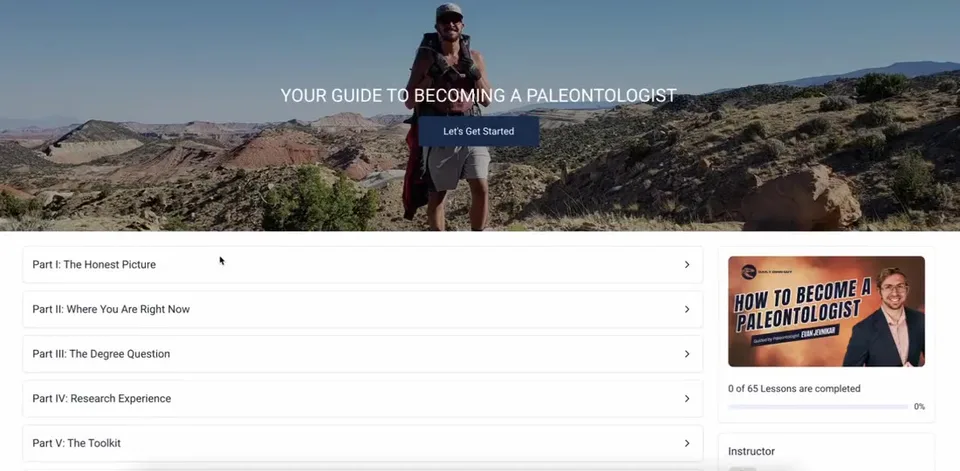
My guide, How to Become a Paleontologist, takes you from picking a major all the way to applying to grad school. I wrote it for students and their parents. $149, or 3 payments of $50, with a full refund within 7 days.
See what’s in the guide →