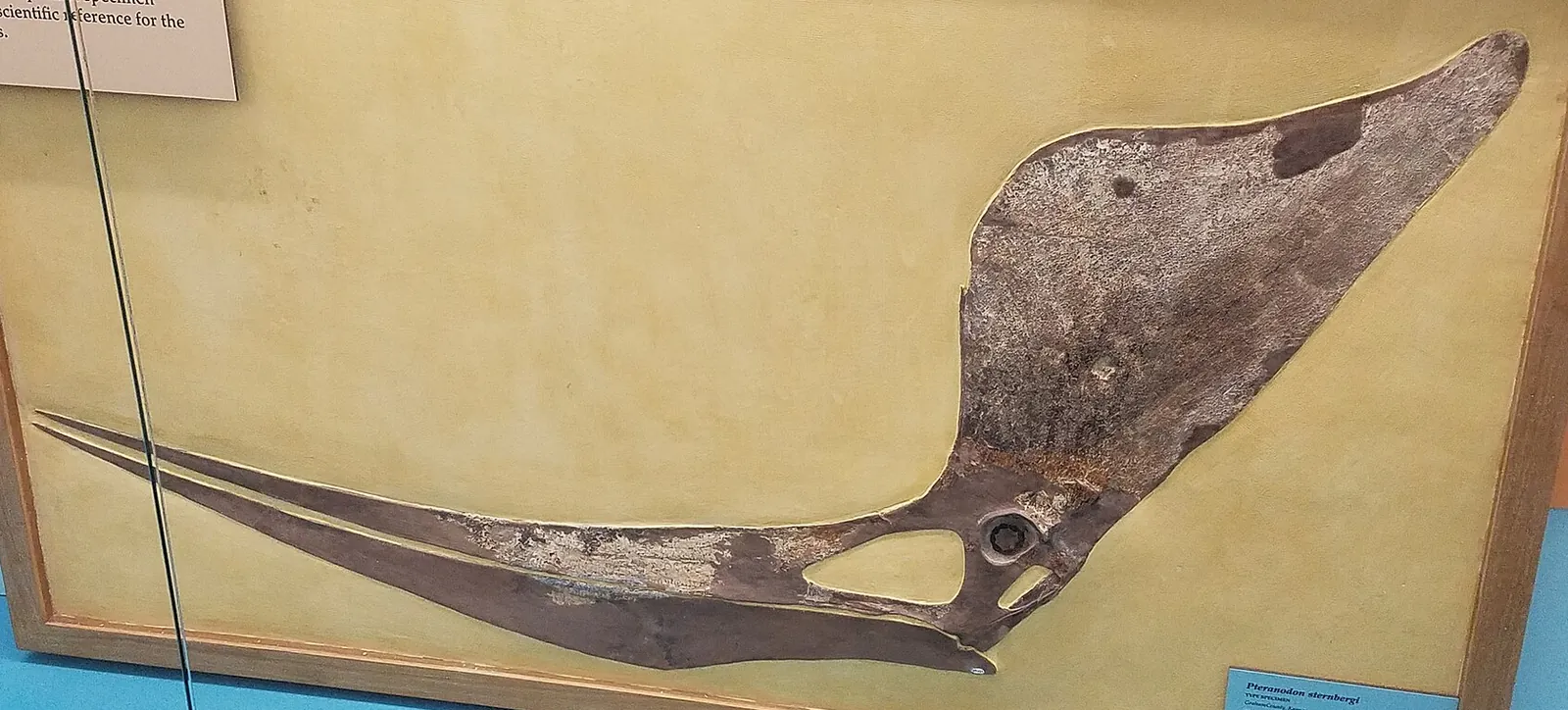
Everyone has been sending me this video. I made a reel about it, and I’m going to tell you the same thing here: as a paleontologist, this is not real, for several reasons.
A lot of you had follow-up questions in the comments about whether pterodactyls were dinosaurs, if they had feathers, how big they got... I linked all the research if you want to dig in!

What’s in the viral pterodactyl video from Mexico?
The clips took off in mid-November 2026. One is security camera footage from the Anapra neighborhood of Ciudad Juárez, right across the border from El Paso. A UFO guy named Jaime Maussan played it on his show and suggested it could be a Pteranodon. A second clip from near the city’s airport showed up after that. Both show a big, dark shape with wings crossing the sky.
Even the city’s Civil Protection director called the videos entertainment and asked people to stop sharing them as news. And in one of the clips there’s text that goes from a blur to actual words, which Snopes caught. Security cameras don’t do that, but AI videos do it all the time.
My reel got picked up by IFLScience (Nov. 18, 2026) and the Hindustan Times (Nov. 17, 2026).
Why I think the video is fake
I only had a minute in the reel, so let me go deeper.
1. It flaps way too much
A pterosaur that big would not be constantly flapping its wings like that. Have you ever watched a vulture or a hawk fly? They barely flap. Mark Witton and Michael Habib found in 2010 that the biggest pterosaurs flapped to launch and climb, then soared. The movement in the video also just looks robotic to me.
The funny part is VICE said one of the “pterodactyls” looked like a frigatebird. Real Pteranodon probably did fly like a frigatebird, gliding long distances over the open ocean. Japanese researchers ran a flight model on it and got the same answer.
2. It’s smooth and scaly
We have solid evidence that pterosaurs were covered in fuzz. Their bodies had hair-like filaments called pycnofibers, and some fossils show filaments that branch like simple feathers.
3. It’s in the wrong place
The animal in the video has a crest and a long beak, so it’s clearly meant to be a Pteranodon. Pteranodon was very common in the American Midwest back when it was an ancient seaway. Its fossils come from the Niobrara Formation in western Kansas, which formed at the bottom of the Western Interior Seaway. Paleontologists have counted more than 1,100 Pteranodon specimens from those rocks, about 97% of all the pterosaurs found there, and some of them were buried hundreds of miles from the nearest shore.
I got my geology degree at the University of Kansas, so I know those rocks. Ciudad Juárez is in the desert. It’s nowhere close to a seaway or an ocean, and it’s not even close to where you would find fossils of a Pteranodon.
Putting all this together, it just looks fake to me.
If someone really wanted to fake a pterosaur near the border, Quetzalcoatlus would have been a better choice. Its first bones were found in 1971 in Big Bend National Park, on the Rio Grande in West Texas, and its family mostly lived inland, so at least it would have been in the right part of the world lol.
Are pterodactyls still alive?
No. Every pterosaur died at the end of the Cretaceous, in the same mass extinction that killed the non-bird dinosaurs about 66 million years ago. The extinction lines up with the Chicxulub asteroid to within about 32,000 years.
After the impact, “Pterosaurs, mosasaurs, plesiosaurs, and hundreds of other species succumbed to extinction.” That’s how I put it in my book.
For a long time it looked like pterosaurs were already on their way out by then, because only one family was known from the very end. A team working in Morocco turned up at least seven species from three families in rocks from the last part of the Cretaceous, so they were THRIVING when the asteroid hit.
If you see big wings in the sky today, it’s a bird. And birds are dinosaurs! Grok even guessed one of the clips was a great blue heron, which isn’t a bad guess.
Is a pterodactyl a dinosaur?
Nope! Pterodactyls are NOT dinosaurs. I’ve made a reel about this at least five times since 2024, and I’ll probably make another one. “Pterodactyl” is just the nickname everyone uses for pterosaurs, so it’s the same answer for those.
They were very close relatives, though. In Surviving Climate and Chaos I described them showing up in the Late Triassic, right alongside the first dinosaurs, as “close cousins of dinosaurs” that “developed wings, making them the first flying animal besides insects to take to the skies,” and that was way before birds showed up.
One of the easiest differences to see is posture. Dinosaurs have a hole right through the hip socket where the thigh bone fits in, which lets their legs stand straight under the body, like ours do. Pterosaurs don’t have that hole.
Their closest relatives were probably the lagerpetids, small reptiles that ran around on the ground and used to be grouped with dinosaur ancestors. CT scans of their skulls show brains that already had features linked to the sharp senses pterosaurs had, before anything in that family could fly.
Pterodactyl vs. Pteranodon: what’s the difference?
The word pterodactyl comes from Pterodactylus, a small pterosaur first named by Georges Cuvier in 1809 from a fossil found in Bavaria, Germany. People started using it for every pterosaur and it stuck.
Pterodactylus lived in the Late Jurassic, about 150 million years ago. The small pterosaurs back then were everywhere. “Species like Pterodactylus were as common as modern-day sparrows or doves.” It wasn’t huge either. Scientists used to think its wingspan was only about 20 inches, until Chris Bennett described a bigger specimen in 2013 that was over 3 feet (about 1 meter) across, with a low crest on its head.
Pteranodon is the one in the photo at the top of this page, and it’s the one the video was going for. It had a big crest sweeping back off its head and no teeth at all. It lived in the Late Cretaceous, tens of millions of years after Pterodactylus, and its wingspan could reach about 24 feet (7.25 meters)!
| Pterodactylus | Pteranodon | |
|---|---|---|
| When | Late Jurassic, ~150 million years ago | Late Cretaceous |
| Where | Solnhofen limestone, Bavaria, Germany | Niobrara Formation, Kansas |
| Wingspan | Just over 1 m at its biggest | Up to ~7.25 m |
| Teeth | Yes | None |
| Crest | Low | Big, swept back |
Sources: Vidovic & Martill, 2014 and Bennett, 2013 for Pterodactylus; Hone, Witton & Habib, 2018 for Pteranodon.
Pterosaurs came in a lot of other shapes too. The Early Jurassic Dimorphodon was “roughly the size of a bull terrier,” with a huge head full of snaggle teeth.
Did pterodactyls have feathers?
Pterosaurs were fuzzy, no question. Whether that fuzz was actual feathers is still a big debate in paleontology. In my book I pointed out that pterosaurs “have been found with fossilized proto-feathers,” and that’s a big part of why I think all dinosaurs probably had some kind of feathery covering.
In 2019, a team in China looked at two small pterosaurs and found several kinds of filaments, including some that branch like simple feathers, with tiny pigment structures called melanosomes inside. Three years later, a Tupandactylus crest from Brazil turned up both wiry filaments and branched feathers, with differently shaped melanosomes in each. The shape of those pigment structures tells us about color, so pterosaurs might have been showing off with colorful feathers.
Some scientists think those “branches” are wing fibers that frayed as the body rotted.
What was the biggest pterosaur?
Quetzalcoatlus northropi from Texas. This thing was as big as a giraffe, and it would have been at eye level with a T. rex! Older estimates gave the biggest pterosaurs wingspans as wide as 43 feet, but Witton and Habib brought that down and put the most reliable upper estimates at about 33 to 36 feet (10 to 11 meters), and 440 to 550 pounds (200 to 250 kilograms).
Quetzalcoatlus belonged to a group of giant pterosaurs called azhdarchids, and they lived all over the world. It probably didn’t go after anything as big as T. rex, but it may have hunted smaller dinosaurs on the ground. Over in Romania, a relative called Hatzegopteryx lived on an island where the sauropods had shrunk way down in size. Their young were “easy pickings for the giraffe-sized pterosaur.”
The Japanese flight model had Quetzalcoatlus walking around on the ground a lot more than flying, but plenty of scientists think it could fly huge distances.
How do you spot a fake pterodactyl video?
There’s going to be another one of these, I guarantee it. When it shows up, watch how it flies first. A giant animal flapping nonstop like a sparrow? Fake. Then look at the skin. If it’s smooth and scaly like in the old movies, it’s fake, because real pterosaurs were fuzzy! And check where it’s supposed to be. If that animal never lived anywhere near there, it’s not real either.
And please do your part and send this to your grandma, your grandpa, or anybody else who might get fooled by the next one.
I also wrote about how the Nanotyrannus debate got settled and about Tarbosaurus, the dinosaur I studied for my thesis. And if you want the full story of pterosaurs and dinosaurs living through 200 million years of climate change, grab my book!
Want the next one of these in your inbox?
Once a month I break down the coolest new dinosaur papers in the Dino Digest, the way I’d explain them to a friend. It’s free, and I link every source.
Get the Dino Digest →